
That answer leads straight to the next question — how? And the first part of "how" has very little to do with AI.
Start with your own bench
Take an honest look at your technology team. Do you have real bench strength in IT, with a history of building complex software and putting it into production successfully? If not, I strongly advise you not to start by evaluating hardware, comparing large language models, or designing your own AI solution.
That may sound obvious. It doesn't mean you should ignore what AI could do for your business, or where it might help you most.
Compare cost per contact, not demos
If you handle a lot of customer contacts — phone calls, text messages, emails — many vendors now sell tools that answer a large share of those contacts automatically and take over part of the work of a contact center's staff. Before you buy anything, look at what already exists. Your current CRM vendor or network provider may already offer tools like these.
The way to evaluate them is simple arithmetic. Work out the cost per contact you would pay with the automated tool, and compare it with what each contact costs you today, whether it's handled by your BPO or by your in-house team. For companies running 10 or more contact center agents, the numbers for these tools are starting to look very compelling.
Just make sure the comparison is complete. Include:
- the one-time implementation cost;
- the project management it takes to get there;
- the work of loading your current response libraries into the new tool.
Growth is the bigger prize
Cheaper support isn't where I see the most value. For companies with $10M to $100M in annual revenue, the bigger opportunity is growth: selling more to new and existing customers. That's where AI can add far more value than a lower-cost way to answer the phone.
This is where I believe AI is heading: tools that "know" your clients, "know" their buying history, and "know" which other products in your portfolio they should be offered, and when. Your sales team could offer choices and options to a prospect in real time, without spending days building custom offers and proposals.
Use automation to grow revenue, not just to build another lower-cost support desk.
That's a direction, not a product you can switch on today. It's also why the groundwork matters now: clean lists, recorded conversations your team actually reviews, and campaign flows you can change without a six-month project.
What we use AI for today
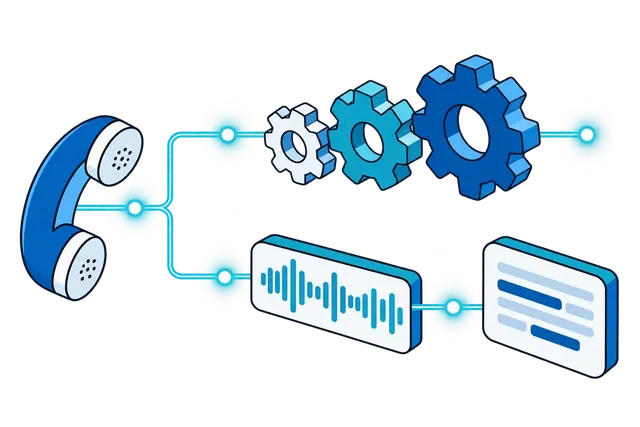
At AcuCall, AI does three narrow jobs: our own speech recognition and text-to-speech in IVR flows, automatic transcription of recorded calls, and automatic redaction of sensitive data in those recordings. Everything else is automation you design with us, plus supervisors who coach your agents live.
If you want to talk through where automation could grow your revenue — not just lower your cost per contact — send me a message. I'll show you how we would approach it.